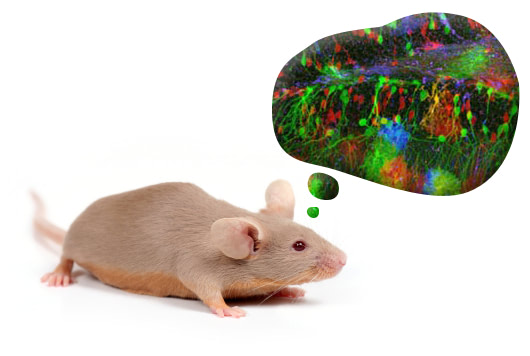
In the 1960s, scientists found that a particular jellyfish makes a protein that glows, known as green fluorescent protein. In the 1990s, using genetic engineering, researchers found that they could take the gene that makes GFP and insert it into the DNA of other cells. This makes different parts of the cell glow - and thus easier to see in a microscope - depending on where the gene is placed.
To go short, Jean Livet, Jeff Lichtman and their collaborators at Harvard University were able to genetically alter mice so their neurons produce fluorescent proteins, and each cell produces a random combination of the colors yellow, red, and cyan. These colors mix, the way the basic colors of a television screen mix to produce a range of hues. Images can be taken in living mice, and the genetic engineering does not harm them. To celebrate this, the scientists decided to appropriately name the species: Brainbow Mice.
guardian.co.uk/science | technologyreview.com | boston.com | www.rsc.org/chemistryworld | nature.com
Related posts: Supermouse experiment | No Transparent Frog | Brain Biometric Key | Brain-computer Interface for Second Life
pascal
now that's nice. I'd like to see it in combination with the see-through frogs (and without the hair). Oh I'd just love to have a brain-glow-in-the-dark translucent mouse as a pet...
Posted on