It might just be my old nature mind, but I still find it a daily miracle: being able to walk into the bakery around the corner and trade a piece of paper – called money – for a loaf of bread. We tend to associate virtuality with video games, but when we think further we realize it has penetrated our lives ages ago. Take money; it is as virtual as the Matrix, but as long as we all believe in it its value it works fine.
Back to Africa. We're not used to Africa taking lead in new technology. Necessity, they say, is the mother of invention and it couldn’t be more true in case of Africa, where pre-paid airtime is fast becoming the ‘virtual’ currency, overcoming conventional currency exchange and lack of banking infrastructure.
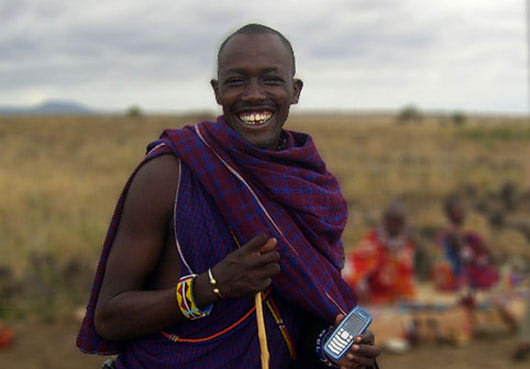
There are over 100 million mobile phones in Africa, and it is one of the fastest growing mobile regions. This number will increase to 378 million by 2011, according to Portio Research. Cell phones are already used for music downloads, text messaging, video games and personal piggy banking. Kenya is home to an impressive cutting-edge mobile tool: M-PESA, the world's only system for sending both minutes and money via SMS. (The "m" stands for mobile. Pesa is Swahili for money.) Airtime minutes automatically load onto the phone of their recipient. The cash is collected from one of the many M-PESA shops dotting the country.
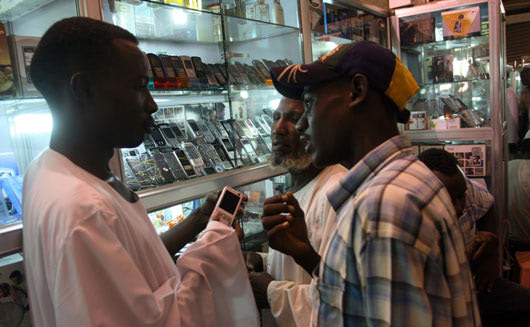
Recently when the violence in Kenya flared up, pre-paid cell phone cards became the most valuable good around. Most people don't have monthly cell phone usage plans – they just buy pre-paid cards as they need them. But when the stores and kiosks that sell the phone cards were closed due to the violence, they became really hard to come by and soon, cell phone credit became more valuable than cash. Charities have even begun distributing the phone cards which recipients then use to buy food and other essentials.
Sources: Why Africa, TheWorld.org, Reuters. See also: Tribal Communication Technology, Fishing by Phone.
Alan
Someone should pop over there and tell them about bitcoin... :)
Posted on
Idowu Ayoola
Absolutely! Last time I was in Nigeria, a week ago, the Ministry of Agriculture in Nigeria is borrowing from this trend/means to give money to local farmers (with hardly civilization) as a means to provide fertilizer subsidy for them. Essentially, they are bridging between Rural farmers, Agro-businesses, banks and the Government through mobile technology.
Posted on
John C. Yaun III
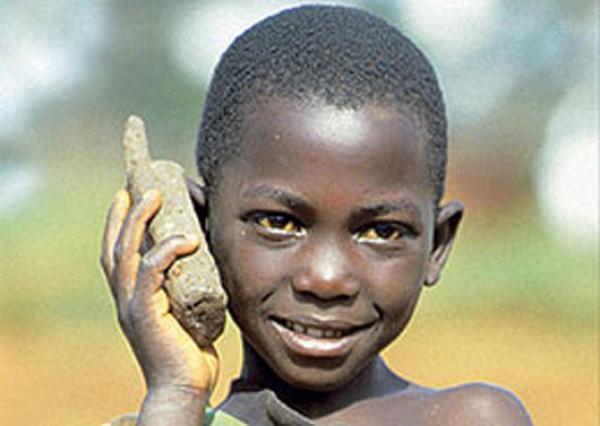
I knew airtime minutes were going to be used as currency one day by millions, when a long time ago I saw a story about using your cell phone to buy a coke from a vending machine. Nokia phones were the main subject of that story. What I need to have happen is for more and more businesses to get a way for them to acccept them as payment. Like scanning your credit card, just push the star key or whatever to pay with your airtime. Nothing more than pointing your phone's earpiece at a terminal and pressing a button or two. Something like that. I want to have a vending machine that will only take plastic credit, any card with value on it, or cell phone airtime, so that the money goes straight into my bank account and not a box at the bottom of the vending machine vunerable to theft. Wouldn't that take the cake, all the way to the bank? So have you heard of such card readers/scanners? This story about cell airtime being currency in Africa and the picture of the mud phone against that young boys face tells a very exciting story of where technilogical advances is going and how it will help third world countries develope at a much faster rate than coventional industrialization or argribusiness could ever do. Connecting to other people with other concepts of how to achieve, or goods and services and using the airwaves to do it, crosses all borders and boundries and eliminates their stopping those connections between those that have and those that need.
Posted on
KingofthePaupers
Jct: Usury-free creationary banking is taking place in so many ways. With Africa trading with mobile-phone minutes, Arabia trading with mobile-phone card credits, with Hours being traded in Ithaca, with tim-based Greencredits being traded in LETS, the banks get no interest. And the movement to cut the middleman out of the usury is growing. With Facebook, Twitter, Graigslist, offering social currencies to their databases, the use of new social credits around the world is undergoing unheralded growth as the slower use of old anti-social credits in a social banking network make the news. This revolution in banking is going on right now and the use of interest-free time-based currency is key.
Posted on
Koert van Mensvoort
Good point Jack.
Posted on
jack
One thing that a lot of people have missed in this recent economic down turn is the fact that in-game money for all of the massive mutliplayer online role playing games has not been effected. I guess it just shows how strong and stable the computer game industry really is. _____________ Jack http://mymmoshop.com
Posted on
john
very fabulous!!!!! jek323x
Posted on
Phalla
Any surplus item can turn into currency. Actually, it would make more sense to use something with more tactile value as trade rather than just paper money. I've read about whole prison populations, devoid of using real money as currency who instead turn to sardines as currency. Seems to operate well for them.
Posted on
Adam
cool and gay like all of you
Posted on
Hendrik-Jan
So... after decades of "charity" for our african brothers and sisters, we can finally conclude that sending money to the forgotten continent has no value. Instead, we maybe should send our simcards? This reminds me somehow of a recent episode of the animation series South Park. In this episode, physical money is discovered as the cure for AIDS as the proximity of dollarbills makes the retrovirus cells go away. The makers suggest that by injecting 180.000 dollar in concentrated form into your bloodstream, people can get cured from this terrible disease. Which of course is a very cynical comment on the current situation that only money is needed to save the lives of thousands and thousands of people dying from AIDS in Africa who are withdrawn from affordable medicine because of pharmaceutical industry standards. Watch a clip of the "Tonsil Trouble" episode on http://www.southparkstudios.com/clips/164373/)
Posted on
Sakura Sa-yo
Amazing. I think the writer makes the point here clearly in "but as long as we all believe in it its value it works fine." A form of currency for the people made by the people(idealistically speaking) may be just what this country can use in a sense , for now at least, to get the power and control back from the corrupt gov't and leaders and where it truly belongs in the hands of the people of the country. Koert .com *above* points out a valid point regarding the govt hs the monopoly on the money otherwise....which in a truly democratic country can work (in a matter of speaking) though I believe this makes the people in charge of the people rather than telecom companies......once the value is shifted once, it is easy to find that something else will come of use as well. And once again..the value currency will change. Save DARFUR!
Posted on
Koert.com
True, talking to family is important, but this is not the point: The cellphone credit isn't just used to make calls, but as a currency to trade goods. - The most fascinating part of this development is that, with paper money, the government has the monopoly on printing money, while with airtime-minute-money this power shifts to telecom companies. This shift should have some major consequences don't you think?
Posted on
=A=
And what can be more valuable than talking to ones friends and family?! ;)
Posted on