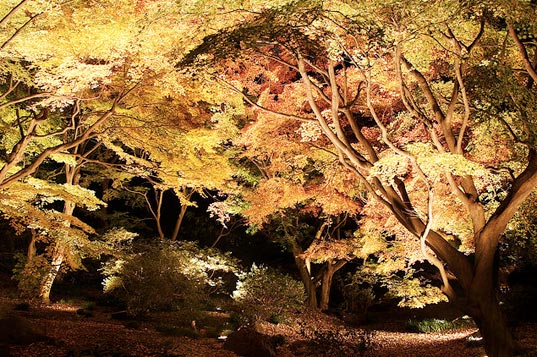
We all know the cellphone masts disguised as trees, created in an attempt to blend technology within the 'natural' landscape. Now Taiwanese scientists have created trees that could function as streetlights. They infused the leaves of Bacopa Caroliniana with gold nanoparticles which causes the chlorophyll to produce a reddish luminescence. This phenomenon is awkwardly named bio-LED by the scientists.
According to Yen Hsun Su of the Academia Sinicia and the National Cheng Kun Univerisity: 'The bio-LED could be used to make roadside trees luminescent at night. This will save energy and absorb CO2 as the bio-LED luminescence will cause the chloroplast to conduct photosynthesis.'
This means that while the tree is ‘lit’ more CO2 is consumed from the atmosphere, therefore the glowing trees could reduce carbon emission, cut electricity costs while still lighting streets safely.
Alejandro Kondraasky
I was waiting for this to happen, i'm very happy to see that it work perfectly :D
Posted on
Glenn
It's certainly a neat trick, but not very sustainable. As leaves reach the end of their life, the gold is lost and the newly formed leaves would not be luminous. A far better solution would be to genetically modify the plant to produce a luciferin/luciferase type reaction. this should then be sustainable and not require the addition of trace elements.
Posted on
Emi
Hm. Wouldn't it be epic if all the ugly peaces of metal and other random materials on our streets that we call 'technology' were to b replaced by stuff like this? Like imagine... umm.. i dunno, postboxes that look like... rocks? Or maybe.. Omigosh houses that are created into hills. Like ya know those eco-homes thatr gettin kinda popular lately? And then the entire world would follow. Technology would no longer be grey and smooth. It would be colourful and wild!! Beautiful!!
Posted on
natinja
And as the tree absorbs more and more CO2, its branches grow and get heavier and get at risk of falling on passerby. Regular maintenance is need, more CO2 is emitted as the branches have to be disposed and discarded. Another sublime example of service/disservice lifecycle.
Posted on
paolo del casa
Those trees are so much "next nature". Indeed we might not be able to see it soon in our street (doubt that the power is enough). Though it would be fun to go and by a 100W tree... after 5 years of watering :) Also it raises again the question that we are enslaving nature. When will we abolish slavery for plants or dogs running to make electricity !
Posted on
pablofiasco
ooooo, id volunteer to play a few of these in my yard, where do i sign up?
Posted on
Marco van Beers
Indeed very similar (or should I say identical) to the proposal Aurey Richard-Laurent made. Interesting to see how visions become reality in a matter of time. Especially if they have very useful benefits (more carbon consummation). Still I doubt we see any of those 'innovations/oddities' to become reality, although a glow in the dark rabbit* is a 'wannahave'. *Glow in the dark rabbit: http://www.thesun.co.uk/sol/homepage/news/article22335.ece
Posted on
Koert van Mensvoort
How very remarkable and how very similar to the proposal Audrey Richard-Laurent made a year ago. https://nextnature.net/2009/07/bioluminescent-trees-will-replace-streetlights/
Posted on