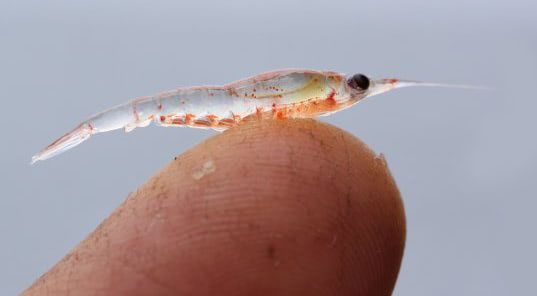
Krill, those tiny members of the ocean's planktonic community, have an importance disproportionate to their size. They are a vital food for whales, penguins and increasingly, humans. Demand for krill-based animal feed and 0mega-3 fatty acids is leading to a "gold rush" in the Southern Ocean off Antarctica.
Harvesting krill is the outcome of a decades-long trend of "fishing down the food web". After humans decimated large oceanic organisms like tuna and swordfish, global fisheries have turned to smaller and less desirable species. Lobster, for instance, was once fed to prisoners, while cod was once so plentiful it was used as fertilizer. Now, fisheries are increasingly snapping up 'bait fish' like anchovies, mackerel and menhaden. The fact that commercial fishermen are now turning to krill, even jellyfish, indicates we may be scooping up the last and least tasty fish in the sea.
'Fishing down the food web' isn't limited to marine environments. Humans began 'hunting down the food web' as soon as we had weapons and tactics sophisticated enough to bring down a mammoth. Our hunter-gather ancestors went after protein sources that would return the most reward for the smallest investment. If the Pleistocene extinctions are anything to go by, early humans' preference for large herbivores like mammoths may have driven them to their extinction.
Though humanity consumes staggering quantities of large domestic mammals like pigs and cows, it doesn't mean that we're not actively looking for the terrestrial equivalent of krill. The UN has recommended research into bug-based food sources, which can be up to five times as efficient as mammalian meat, to solve the developing world's protein crisis. Companies are springing up that market bug nuggets and muesli. Lab-grown meat, which doesn't even need a whole, living animal, can be thought of another manifestation of the race to the bottom.
There's no doubt that the more efficient production of protein is essential: less carbon, less water waste, less habitat loss. But however admirable the benefits, the only reason we're turning to plankton and petri dishes is out of necessity. Though seafood is the last commercially viable wild food, the fact that we're scraping the bottom of the fisheries barrel indicates we're nearing the end. 'Feeding down the food web' is coming to the logical conclusion of a 11,000 year old trend. Technology has triumphed, but for anyone who enjoys their protein big, wild, and with a backbone, the days of steak and plenty are over.
Photo via Upwelling.
Peter Jones
Interesting view, Allison. The issue that I have is that the worlds' population is growing so rapidly that the natural habitats of our animals is being wiped out by the new time. Man seems to assume that he should have the priority over wildlife, when wildlife has been here a lot longer than man himself. I fail to understand why we should continue to drive forward with manufactured foods to support an ever expanding human race. Of course this argument leads to all sorts of issues such as company profits, shareholder dividends etc. etc. At the end of the day I still would prefer to let nature take its course and not support starving over-productive races. I would much prefer to see the elephants and rhino's back on the African plains and the whales back in the oceans than a lot of waring races in Africa and the middle east. One of my facourites, the manitee, is being driven to extinction simply because people in places like Florida want to spend their leisure time flying about in powerboats and by doing so are destroying the natural habitat of these wonderful, ancient creatures. If scientists manage to clone mammoths then perhaps they will also succeed in cloning dinasaurs, who in turn may perhaps run riot and wipe out large parts of the human race - now that would be a great result !!
Posted on
Allison Guy
Most (if not all) human famine is related to inefficiencies in food distribution and storage. Almost half of the world's food get thrown away. So, while humans are ruinous to the planet in all other aspects, we're perfectly able to feed a far larger global population than we currently do.
Posted on
Peter Jones
I can never understand, whenever discussions are put forward about how we can feed the worlds' population, the enormously obvious issue to the endangerment of animals whether on water or land is that there are just too many people on the earth and there are a limited amount of resources. I get sick of hearing commentators discussing how and where man is going to find the resources to feed the far east, or Africa, when the answer is staring us in the face - we shouldn't. Eventually humans will outnumber the food supply to the extent that there will be no living animals left, when the solution is to curb the increase of humans. The Chinese do appear to be trying to do something to relieve the dire overcrowding that exists in Chine today, and well done to them. When you see television adverts asking for charitable donations because 3 million children die each year in Africa from starvation I ask the question - who exactly would feed the annual extra 3 million mouths who would be increasing the world population and demanding resources. 10 years - and extra 30 million or more people. I am not defending the west either, as the west is no better. It is a stark choice - reduce less human beings on the planet or no animals. I would sooner have the animals anyday.
Posted on