The World without Technology
I remember the smoke the most. That pungent smell permeating the camps of tribal people. [...]
With our attempts to cultivate nature, humankind causes the rising of a next nature, which is wild and unpredictable as ever. Wild systems, genetic surprises, autonomous machinery and splendidly beautiful black flowers. Nature changes along with us.
Despite the global awareness of our fragile relation with nature and the countless projects initiated to restore the balance, almost no one has asked the question: What is our concept of nature? And how is our relation with nature changing?
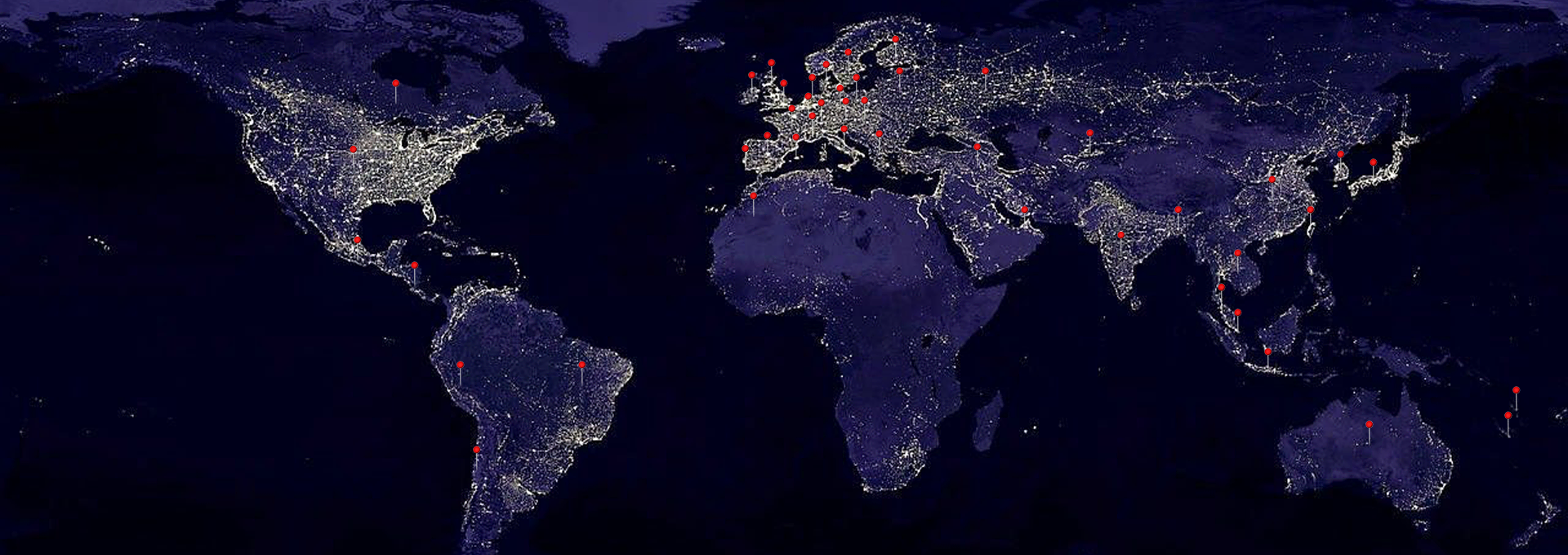
Today the human impact on our planet can hardly be underestimated. Climate change, population explosion, genetic manipulation, digital networks, plastics islands floating in the oceans. Untouched old nature is almost nowhere to be found. “We were here”, is written all over.
We are living in a time of rainbow tulips, palm-shaped islands, hurricane control and engineered microbes. An age in which the ‘made’ and the ‘born’ are fusing. This does not mean however, that we have become gods and have control over our own destiny. Rather, our relation with nature is changing.
Where technology and nature are traditionally seen as opposed to each other, they now appear to merge or even trade places. While old nature, in the sense of trees, plants, animals, atoms, or climate, is increasingly controlled and governed by man – it is turned into a cultural category –, our technological environment becomes so complex and uncontrollable, that we start to relate to it as a nature of its own.
Nowadays, children know more corporate logo’s than bird or tree species. The average Western person is more concerned about the mortgage interest deduction than about hurricanes or floods. There may even come a moment that our connection with an industrially manufactured coke bottle may be richer and more mythical than our relation with a genetically analyzed and manipulated rabbit in the woods.
This website explores our changing notion of nature. How nature has become one of the most successful products of our time, yet much of what we perceive as nature is merely a simulation: a romanticized idea of a balanced, harmonic, inherently good and threatened entity. How evolution continues nonetheless. How technology – traditionally created to protect us from the forces of nature – gives rise to a next nature, that is just as wild, cruel, unpredictable and threatening as ever. How we are playing with fire again and again. How we should be careful in doing so, yet how this is also what makes us human.
Nature changes along with us. We are wandering around in our magic garden that may take us by surprise and astonish us, that may also knock us down or be kindly disposed to us. Will we be able to improve our human condition, or will we outsource ourselves for good? People are catalysts of evolution, yet we are only beginning to get attuned with this job description. At least we can be certain of one thing. In the end we will get the nature we deserve.
Hence the need to explore how we can design, build and live in the nature caused by people.

I remember the smoke the most. That pungent smell permeating the camps of tribal people. [...]
At the edge of the woods along the motorway near the Dutch town of Bloemendaal, [...]
Lecture spoken by Henk Oosterling at Biggest Visual Powershow, Zollverein Essen, Germany, 23 June 2006
Damen [...]
Written by Koert van Mensvoort, published in Next Nature Pocket, 2005 and in Entry Paradise, [...]


On this website we explore our changing relation with nature. We aim to visualize, research and understand the implications of the up-and-coming next nature on our everyday lives.
If you want to contribute something to the site, like an article, picture or something else. Please see the contribute section.
Would you like to advertise on Next Nature? Please contact Protein.
For contacting one of our regular authors, look up their email address at the authors page.
If you want to hire us for a lecture at your conference, university or festival. Make sure you include info on the event, preferred date, venue, theme or topic and your organization when you contact us at: lectures@nextnature.net
For all other questions and remarks, you can reach us at:
post@nextnature.net